
Where Did the Broadband Money Go, and Where Is the Internet?
Harrison County has 3,056 broadband locations classified as funded but not yet served. As the region attracts aerospace investment, technology employers, and new economic development, Gary Keith II asks where the broadband money went and when residents will see the results.
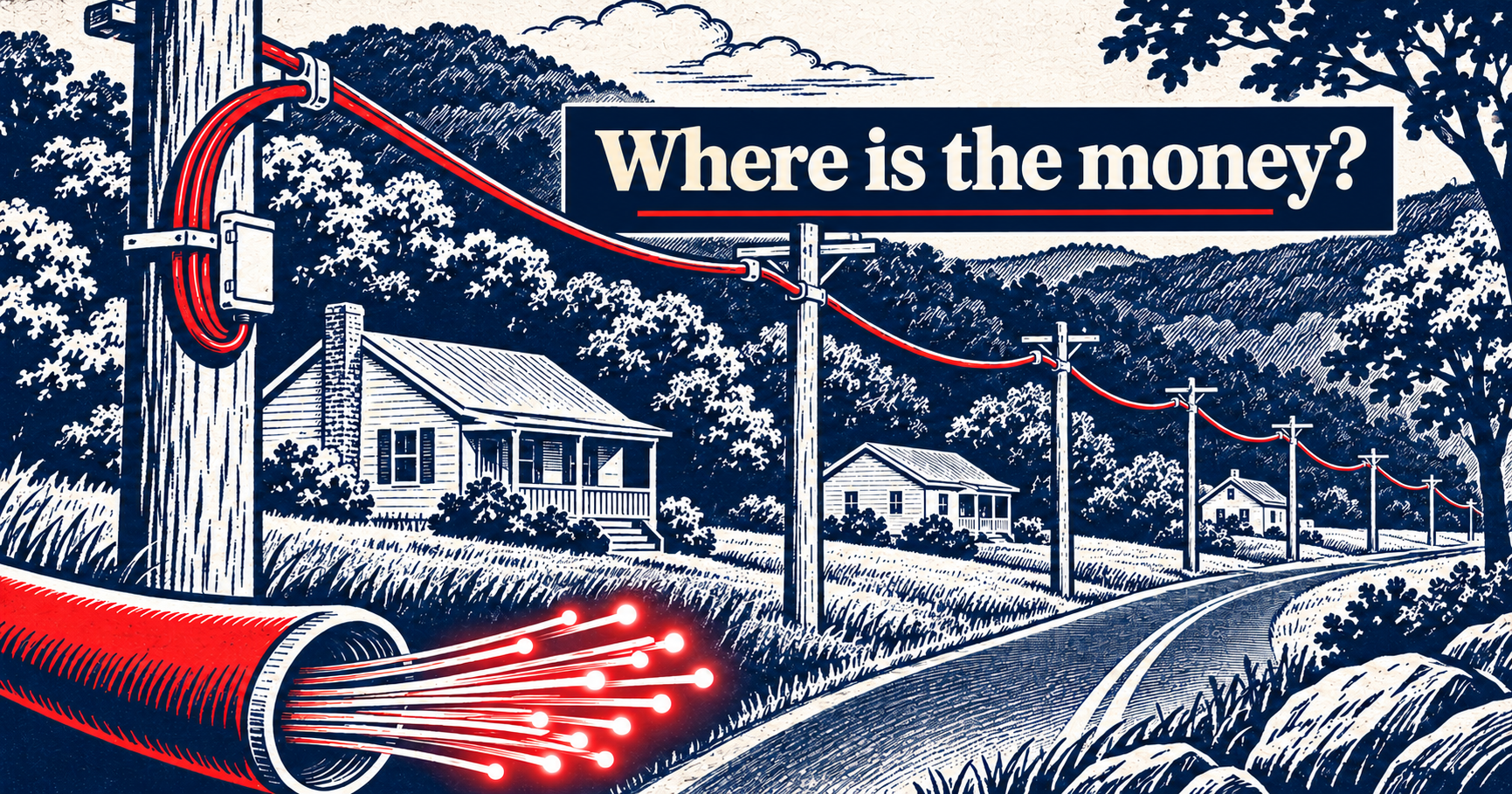
For years, West Virginians have been hearing about millions of dollars being committed to expanding high-speed internet. We've heard the announcements, seen the promises, and watched government officials celebrate another round of broadband funding.
But here's a question worth asking.
Where is the internet?
According to the latest figures published by the West Virginia Office of Broadband, Harrison County has 3,056 locations classified as funded but not yet served.
That's 3,056 locations where funding has been identified for broadband expansion, but the state's June 2026 snapshot did not show service completed.
Another 451 locations were classified separately as unserved or underserved.
And here's what makes those numbers particularly frustrating to me.
We're talking about Harrison County, West Virginia. Not some remote, isolated corner of the state.
Harrison County is the seventh-largest county in West Virginia by population. We're situated in north-central West Virginia, at the crossroads of Interstate 79 and U.S. Route 50, two of the state's most important transportation corridors.
We have the FBI's Criminal Justice Information Services Division, a growing aerospace industry surrounding the North Central West Virginia Airport, major health care facilities, and continued efforts to attract new businesses and investment.
We're trying to position this region as a center for commerce, technology, and economic development.
And yet, the state’s June figures showed thousands of funded locations in our own county still waiting for broadband. How many of them can get connected today?
How are we supposed to build a modern economy when some of the people who live here still can't get the internet service that modern employment requires?
Think about that for a minute.
We're investing in airport infrastructure and attracting employers that depend on sophisticated technology, while residents who might want to work remotely, start a home-based business, or pursue online education can find themselves limited by inadequate broadband availability.
A dependable high-speed internet connection isn't a luxury anymore. It's basic infrastructure, just like roads, water, and electricity.
Without it, we're putting part of our own workforce at a disadvantage.
Businesses need employees who can work, train, communicate, and compete in an increasingly digital economy. Families need reliable connections for education, health care, and everyday life.
And if we want young people to build their careers and raise their families here instead of leaving for better opportunities, broadband access needs to be part of that equation.
We can't spend all our time talking about economic development while overlooking the infrastructure that allows our residents to participate in it.
Which brings me back to those 3,056 locations.
Where did the money go? Who was awarded it? How much has actually been paid? What work has been completed? And perhaps most importantly, when are these residents finally going to get the service they've been hearing about?
This isn't a new conversation.
In January 2022, the state announced $1,191,534 in grant funding for Citynet's Green Valley Line Extension project, intended to bring approximately 26 miles of fiber to 265 addresses.
The state's 2025 annual report lists that project in the closeout stage. That's encouraging, but I would still like to see the final expenditures, completion records, and confirmation of which addresses can now obtain service.
And that's just one project.
What about the others? Which companies are responsible for serving the 3,056 locations identified in the latest report? How long ago were those funding commitments made? How much money has actually changed hands?
I don't think those are unreasonable questions.
Look, I understand that construction projects encounter delays. There are engineering challenges, permitting requirements, utility pole issues, and plenty of other legitimate reasons something might take longer than expected.
But here's the thing.
A legitimate reason for a delay is not a reason to leave the public in the dark.
If funding was awarded years ago and work remains unfinished, tell us why.
If the money hasn't been released, tell us what's holding it up.
If it has been spent, show us what taxpayers received in return.
And if the work has been completed, show us which addresses can actually receive service.
We have become remarkably good at announcing government projects. Press conferences, photographs, oversized checks, and glowing promises about the future.
What I would like to see is the same enthusiasm for reporting the results.
Not another announcement about how much money is available.
Not another promise about what might happen someday.
An actual accounting of what was awarded, what was spent, what was built, and what remains unfinished.
The West Virginia Office of Broadband collects information about these programs. I would like to see that information presented in a straightforward, county-by-county report that ordinary taxpayers can understand.
For Harrison County, tell us who received the awards, when the money was committed, how much has been disbursed, and when the remaining work is supposed to be finished.
I am not suggesting anyone has stolen a dime or done anything improper. I have seen no evidence establishing that.
But I also don't believe taxpayers should have to spend hours digging through government reports just to figure out what happened to money that was supposed to improve their communities.
And I certainly don't believe asking for accountability should be controversial.
The public deserves more than a funding announcement. It deserves a completion date, a financial accounting, and an explanation for every unfinished project.
Here's Who You Can Contact
If you're among the Harrison County residents still waiting for broadband expansion, or simply want to know how public funding is being administered, I encourage you to contact the people responsible for overseeing these programs and representing our communities.
West Virginia Office of Broadband
Kelly Collins Workman, Director
Phone: 304-558-2234
Email: Kelly.A.Workman@wv.gov
Website: https://broadband.wv.gov/
Our State Senators
Senator Ben Queen, District 12
Phone: 304-357-7904
Email: ben.queen@wvsenate.gov
Senator Patrick Martin, District 12
Phone: 304-357-7845
Email: patrick.martin@wvsenate.gov
House of Delegates
Delegate Clay Riley, District 72
Phone: 304-340-3144
Email: clay.riley@wvhouse.gov
Newly Elected or Reelected House Members
Danny Hamrick, District 69
Public campaign email: danny@hamrick.cloud
Shannon Welsh, District 70
Public campaign email: shannon@welshforhouse.com
Tim McNeely, District 71
Public campaign phone: 304-848-9233
Public campaign email: tim@mcneelyforwv.com
Official contact information for the incoming legislative term should be checked at https://home.wvlegislature.gov/ as offices are assigned and updated.
Here are six questions worth asking:
- Which broadband projects have received funding commitments in Harrison County since 2021?
- Which companies or organizations received those awards, and on what dates?
- How much money has actually been disbursed to each recipient?
- How many of the promised service locations have been completed and verified?
- Which projects are behind schedule, and what is preventing their completion?
- When are the 3,056 locations identified as funded but not yet served expected to receive service?
I think our elected representatives, including those preparing for the next legislative term, have an opportunity to help get these answers.
Not because they necessarily caused the problem, but because representing the public includes helping people get results.
If there are perfectly reasonable explanations for the delays, let's hear them.
If projects are progressing exactly as scheduled, let's see the schedules.
We're working to build an economy that attracts technology companies, aerospace investment, and high-paying jobs. That ambition needs to extend beyond the walls of our largest employers and into the neighborhoods where our workforce actually lives.
We can't claim to be building the economy of tomorrow while leaving thousands of locations waiting for the infrastructure of today.
If millions of dollars are committed to expanding broadband in Harrison County, the people of Harrison County ought to be able to follow that money from the original announcement all the way to an actual working internet connection.
So I'll ask again. Where did the money go, and where is the internet?
I'd like to see someone answer that question.
And I suspect plenty of Harrison County residents would, too.
Sources & further reading
West Virginia Office of Broadband, Harrison County Availability Map, page 17 ↗West Virginia Office of Broadband, Harrison County Program Map, page 17 ↗West Virginia Office of Broadband ↗West Virginia Legislature ↗Clarksburg News and Observer broadband reporting ↗West Virginia Office of Broadband 2025 Annual Report ↗See something that needs a correction?
Include the article title and the specific information we should check.
Continue the Conversation
Have something to say about this story? Join the discussion in our Clarksburg News and Observer Facebook community.
Visit Our Facebook GroupCommunity comments are participants’ views and are not verified Observer reporting.